

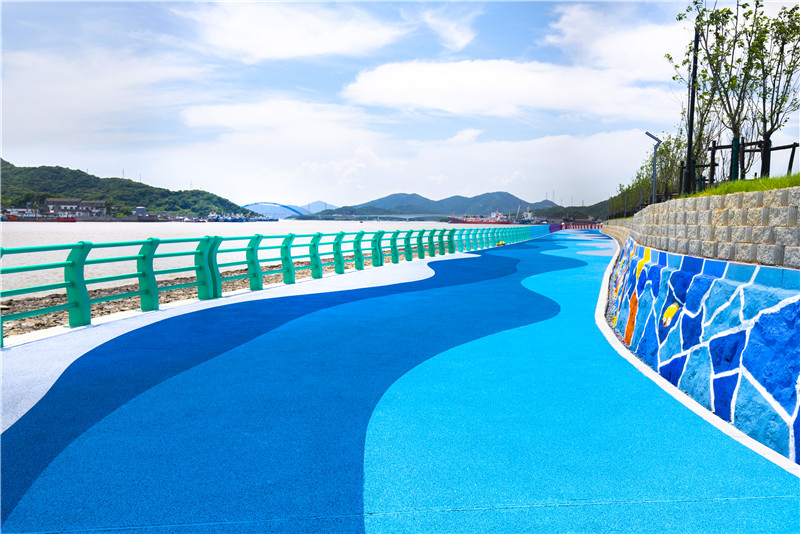


Guide to Resin Bound Gravel: Making and Choosing Adhesives
Resin bound gravel (also called resin bonded or permeable resin paving) is gaining huge popularity for driveways, patios, parks, and even parking lots thanks to its good looks, high permeability, and strong load-bearing capacity.
But have you ever run into problems? The gravel looks dull because the glue covers its natural color. Or the two-part adhesive didn't mix properly and failed to cure. Maybe your adhesive got stuck at customs and the whole project was delayed.
Today, we’ll walk you through how to make resin bound gravel – and introduce a single-component adhesive that solves all the headaches. It makes your job easier, keeps the gravel's true color, and ships safely anywhere.

1. How to make resin bound gravel step by step
The principle is simple: use a clear, strong adhesive to bind dry aggregate (natural colored stones) together, then compact it to form a permeable surface. Here are the four key steps.
1.1 Base preparation
The surface must be solid, clean, dry, and free of grease. For a concrete base, apply an interface sealer first to prevent alkali attack or poor adhesion.
1.2 Aggregate preparation
Use natural colored stones (e.g. Dandong Green, Golden Stone, Ice Crack Stone) with particle sizes of 2–5mm or 3–6mm. The aggregate must be completely dry (moisture content <0.5%). Wet stones will seriously affect bonding and may even prevent curing.
1.3 Mixing adhesive with aggregate
This is the most critical step. Add adhesive to the aggregate and mix until every stone is coated.
- Traditional two‑component adhesives require weighing, mixing, and a strict pot life – any mistake ruins the batch.
- Single‑component adhesive: open the bucket and pour directly. No measuring, no mixing – faster and foolproof.
1.4 Laying, compacting and curing
Pour the mixture into the mold or work area, level it with a screed or roller, and compact lightly (do not over‑roll – this can force adhesive to the surface). Allow 6–12 hours for foot traffic, and 24 hours for light vehicles.
2. The heart of resin bound gravel: choose the right adhesive
Many people only ask "does it stick?", but ignore two hidden killers: yellowing and color masking. Ordinary two‑component epoxy or polyurethane adhesives often leave a hazy film that dulls the stone's bright colors. Worse, they yellow after a few months, making the whole surface look old and dirty.
Our BES single‑component resin bound adhesive was designed to solve these problems completely.
3. Why choose single‑component adhesive? Four big advantages
✅ Advantage 1 – Crystal clear – never changes the stone's natural color
BES single‑component adhesive cures to a fully transparent, colorless finish. It's like an "invisible armor" for each stone. Whether you use dark green, golden yellow, or pure white aggregate, the original color, luster, and texture are preserved – no gray haze, no yellowing. After 1,000 hours of accelerated UV aging testing, only minor discoloration was observed – far better than ordinary adhesives.
Compared to two‑component: Many two‑component adhesives use hardeners that are themselves dark yellow or reddish‑brown, making true transparency almost impossible. The finished pavement often has an unwanted "glue color".
✅ Advantage 2 – Single‑component – no mixing, lower dosage, super easy
This is the most obvious benefit. Single‑component adhesive is ready to use straight from the bucket. No need to weigh Part A and Part B, no mixing, no risk of uneven ratios.
What you do:
- Open the lid
- Pour into the aggregate
- Mix
That's it. And thanks to a more efficient formulation, the dosage per square meter is about 15–20% lower than typical two‑component systems. You save money and time.
Compared to two‑component: You need precise scales, an electric mixer, and you have to work fast within a limited pot life. One mistake and you scrap a whole batch. Not friendly for new crews.
✅ Advantage 3 – Safe composition – non‑hazardous, easy shipping, no customs trouble
This is a huge hidden issue for many export projects or even domestic logistics. Traditional two‑component adhesives often contain amines, isocyanates, or other hazardous ingredients classified as Class 8 corrosives or Class 3 flammable liquids. Sea freight, air freight, and even trucking require dangerous goods packaging, special transport, MSDS documentation, and customs declarations. Once inspected, your goods can be seized, returned, or fined.
Our BES single‑component adhesive is formulated to contain no hazardous labeling ingredients. It has been certified as non‑dangerous goods under normal chemical classification. Whether you ship domestically or export to Europe, America, or Southeast Asia, it can be transported and declared as ordinary cargo – saving you time, costs, and regulatory headaches.
Real case: A client ordered two‑component adhesive from Malaysia. Customs detained it, causing a 45‑day shipping delay and huge job‑site losses. After switching to our single‑component adhesive, they cleared customs in one week and received the goods smoothly.
✅ Advantage 4 – Strong performance – high strength, water resistant, good permeability
Don't think that easy operation means weak performance. Independent lab tests show excellent results:
| Property | BES single‑component adhesive – actual test values |
| Compressive strength | 35 – 60 MPa |
| Tensile bond strength | 3.1 – 5.5 MPa |
| Flexural strength | 4.0 – 6.5 MPa |
| Permeability coefficient | ≥ 3.2×10⁻² cm/s |
| Water resistance | 7 days water immersion – no blistering, no peeling, no discoloration |
| Adhesion rating | Grade 2 |

What this means: It can handle parking, vehicle traffic, rain soaking, and still drains water fast.
4. How to make resin bound gravel with single‑component adhesive – quick guide
- Clean the base
- Dry the aggregate (moisture <0.5%)
- Pour single‑component adhesive directly onto the aggregate
- Mix for 30–60 seconds – every stone coated
- Lay and level with a screed or roller
- Lightly compact
- Cure for 6–12 hours
- Open to traffic
Compared to two‑component systems, you save at least 30% of construction time – no weighing, no premixing, no panic over pot life.
5. Frequently Asked Questions
Q: Is single‑component adhesive weaker than two‑component?
A: Not at all. The compressive strength reaches up to 60 MPa – that's equivalent to C50 concrete, more than enough for ordinary parking lots, sidewalks, and residential roads.
Q: Do I need to add a hardener?
A: No. It cures by itself using moisture or specific environmental conditions – just open and use.
Q: Is it suitable for export?
A: Yes. It is classified as non‑dangerous goods under normal chemical regulations. Sea and air freight as ordinary cargo – no customs troubles like two‑component systems.
Q: Can it be applied on a damp surface?
A: No. Like any resin bound system, both the base and the aggregate must be dry for good adhesion.
Final words
The beauty of resin bound gravel depends half on the stone, half on the adhesive. The wrong adhesive will make expensive stone look gray, yellow, and eventually loose. The right adhesive makes even ordinary stone look premium.
Our BES single‑component resin bound adhesive is built on three key words: clear, simple, safe – saying goodbye to the hassle and risk of two‑component systems.
If you are looking for:
- A highly transparent adhesive that won't yellow or mask stone colors
- A ready‑to‑use adhesive with no mixing – just open and pour
- A non‑hazardous adhesive that ships easily and clears customs without trouble
Contact us. We offer free samples, technical guidance, and construction support.
Let every stone show its true color.

Request a free sample & quote
Leave a comment or message us: project type + area + need for export
We'll get back to you with a tailored solution.
Original content by BES technical team. Unauthorized reproduction is prohibited. Data based on lab test results. Always follow the product datasheet for actual construction.